
When an unexpected expense like a car repair or medical bills shows up, you want options you can quickly understand and act on with confidence. Installment loans and payday loans are among the most common types of loans, but they work differently. Knowing how each one works helps you choose the one that fits your budget and timeline.
In this guide, you’ll learn exactly how each option works and what sets them apart so that you can decide with clarity. Keep reading to learn more.
What are installment loans and payday loans?
An installment loan gives you a set amount of money that you repay in equal, scheduled payments over weeks or months. Each payment covers a portion of what you borrowed plus interest, so your balance shrinks steadily until you’ve fully paid it off.
Because the payments are predictable and the same size each time, this option is easy to plan around and build into your monthly budget.
A payday loan is a smaller, faster form of credit. You borrow a modest amount (often between $100 and $1,000) and repay it in a single lump sum, typically on your next payday.
This type of borrowing works well for speed and simplicity. It usually doesn’t require a strong credit history, which makes it accessible when you need cash right away and don’t have time to wait.
Both are short-term loans, designed to bridge a temporary gap rather than serve as long-term financing. The core difference comes down to structure. One spreads repayment into several smaller payments over time, while the other is a single payment made up front on your next paycheck.
How to choose between installment loans and payday loans
Picking the right option is easier when you take it one step at a time.
1. Decide how much you actually need. Borrow to cover the specific expense in front of you. A smaller amount is faster to repay and costs less overall.
2. Look at your repayment timeline. If you are able to comfortably repay the full amount by your next payday, the single-payment option may be a good fit. If you need to spread the cost over several paychecks, an installment loan gives you breathing room.
3. Understand the cost. The lump-sum option usually charges a flat fee, often around $15 per $100 borrowed, because it’s meant to be repaid within a couple of weeks. That keeps a payday loan’s cost quick and finite.
A scheduled-payment plan, by contrast, charges interest that accrues over the life of the loan. Knowing the total dollar cost of each helps you compare them fairly.
4. Check your state’s rules. Short-term lending regulation occurs at the state level, so available amounts, terms, and fees vary by state. A licensed lender will automatically apply your state’s rules.
5. Read the full terms. Look at the due date, the total repayment amount, and extension options if your circumstances change. A transparent lender makes all of this easy to find.
6. Make your repayment plan first. Before you accept anything, know exactly which paycheck(s) will cover it. Borrowing with a plan already in place is the single best way to keep the experience smooth.
Benefits of each type of loan
Each choice has real strengths, and matching those strengths to your situation leads to a good experience.
Choose the fast, single-payment route when you need:
- Fast access to cash, often the same day
- A simple process with minimal paperwork
- Approval without a strong credit history
- A short, clean repayment tied to your next paycheck
Choose the scheduled-payment route when you need:
- A larger amount than a single paycheck covers
- Predictable, equal payments that are easy to budget
- A longer window to repay comfortably
- A steadily shrinking balance you watch disappear
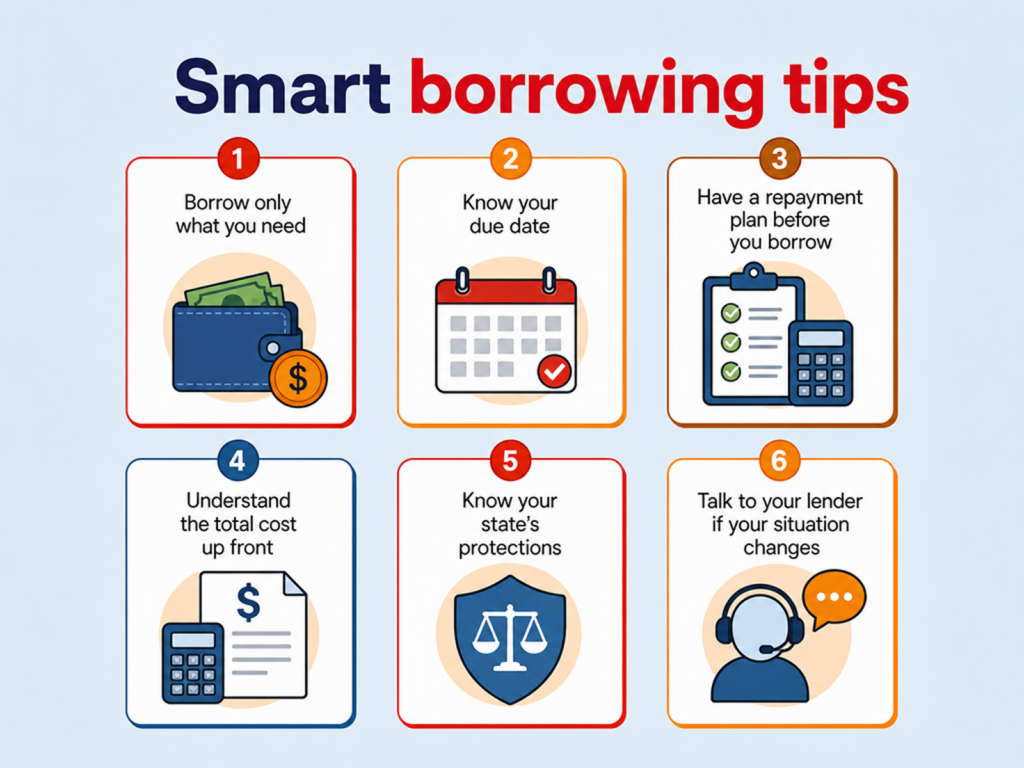
Smart borrowing tips
A few simple habits help any borrower get the most value from short-term loans:
- Borrow only what you need. The smaller the balance, the easier and cheaper it is to repay.
- Know your due date. Mark it on your calendar so repayment lines up with your paycheck.
- Have a repayment plan before you borrow. Knowing where the money will come from keeps everything on track.
- Understand the total cost up front. Look at the full amount you’ll repay.
- Know your state’s protections. Regulations exist to keep the process fair, and a licensed lender follows them.
- Talk to your lender if your situation changes. Good lenders would rather work with you than leave you guessing.
Data and statistics
A quick look at the numbers helps put short-term borrowing in context:
- Millions of Americans rely on installment and payday loans each year, according to research from the Pew Charitable Trusts.
- A typical single-payment advance is small, generally a few hundred dollars, and tied to the borrower’s pay cycle.
- These fees are commonly expressed as about $15 per $100 borrowed, which the Consumer Financial Protection Bureau (CFPB) notes reflects the short, roughly two-week repayment window.
- Spreading repayment over several months is what gives the scheduled-payment approach the predictability many borrowers prefer for larger expenses.
What to look for in a lender
Choosing a trustworthy lender matters as much as choosing the right structure. Look for:
- Transparent fee disclosure — every cost stated clearly before you sign
- Proper state licensing — a sign that the lender follows your state’s rules
- A clear repayment schedule — no surprises about when and how much
- Responsive customer service — real people you reach with questions
- Flexible options — a lender willing to work with you if plans shift
FAQ
Q: Can you have a payday loan and an installment loan at the same time?
Generally, yes. They’re separate products, often from different lenders, so having one doesn’t automatically block the other. The real limit is your state’s rules: many states cap how many payday loans you hold at once, but that count usually excludes installment loans. It’s important to make sure your budget covers both repayments.
Q: Is a payday loan secured or unsecured?
A payday loan is unsecured. No collateral, like a car or house, backs it. Instead, you write a post-dated check or authorize a withdrawal from your bank account on the due date, which gives the lender assurance of repayment. Note that car title loans look similar but are secured by your vehicle.
Q: Which type of loan is easier to qualify for?
The single-payment option is often the most accessible because it typically doesn’t require a strong credit history. Longer, scheduled-payment financing may involve a bit more review since the amounts and terms are larger.
Q: How do I know which one is right for me?
Match the loan to your expense and timeline. If you repay in full by your next paycheck, the fast option may be a good fit. If you need a larger amount spread over time, structured installments are likely the better choice.
Q: Are short-term loans available in my state?
Availability, amounts, and terms vary by state. A licensed lender will show you exactly what’s available where you live and automatically apply your state’s rules.
Ready to move forward with confidence? Contact USA Cash Services
Whether you need a payday loan to bridge a short gap or an installment loan to handle a larger expense over time, USA Cash Services is here to help you find the right fit for your situation. Our team makes the process easy with clear terms. Explore your options, and let USA Cash Services help you take the next step.