

When you need money quickly, the last thing you want is confusion about who you’re actually borrowing from. Yet many people applying for emergency loans online never realize whether they’re working with a lender that funds the loan directly or with a middleman that simply passes their information along.
That single distinction shapes how fast you get funded, who holds your loan, and who to call when a question comes up.
In this guide, you’ll learn the following:
- Exactly how these two models differ
- Why the difference matters for your wallet and your peace of mind
- How to confirm who you’re really dealing with before you sign anything
Keep reading to learn more.
What is a direct lender?
A direct lender is exactly what the name suggests: the company that lends you the money itself. It takes your application, reviews it, makes the approval decision, and deposits the funds. When it’s time to repay, you pay that same company back, with no third party in between. A lender is a financial institution that makes loans directly, while a broker doesn’t lend money at all.
The biggest advantage of borrowing directly is clarity. You know who holds your loan and who to contact with questions. You know exactly what your terms are from day one. For borrowers seeking emergency loans, that single point of contact makes the whole process faster and far less stressful.
What is a loan broker?
A broker, sometimes called a lead generator in the short-term lending world, doesn’t lend you anything. Instead, they collect your information and pass it along to a network of possible lenders. They then match you with one who might approve you. The actual money still comes from a lender working behind the scenes.
Lead generators take your information and send it to a network of possible lenders. Be careful, since these services may not find you the cheapest loans. Such sites often use phrases like “matching you with lenders” or “connecting you with a network of participating lenders.”
A broker is genuinely useful if you want to compare several offers without applying to each company individually. But there’s a trade-off. Your personal details may be shared with multiple businesses at once, and you might not know up front which one will ultimately hold your loan.
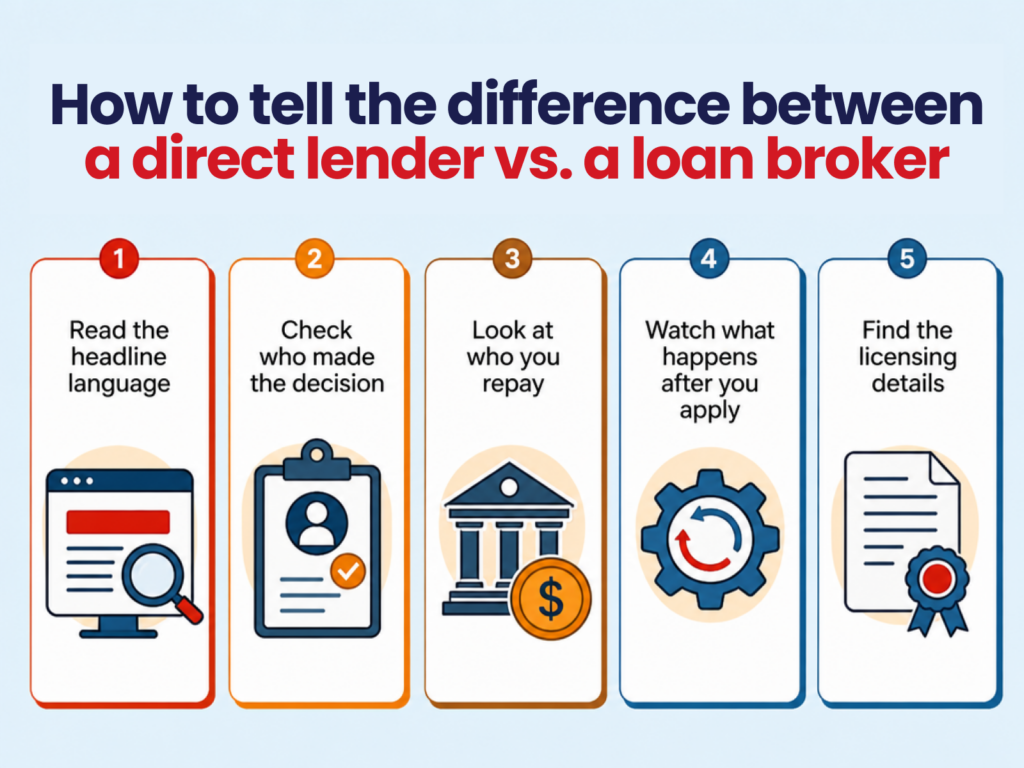
How to tell the difference
It isn’t always obvious which type of website you’ve landed on. Here’s how to spot the difference quickly:
- Read the headline language. Phrases like “we match you with lenders” or “our network of partners” usually point to a middleman. A company that funds its own loans speaks in the first person: “we lend,” “we fund,” “we approve.”
- Check who makes the decision. If the site explains that another company will review your application, you’re likely dealing with an intermediary.
- Look at who you repay. When the same company that gave you the money also collects the payments, you’re borrowing directly.
- Watch what happens after you apply. A sudden flood of calls or emails from several companies usually means someone shared your information with a larger network.
- Find the licensing details. A legitimate lender will typically display its state licensing or registration clearly on the site.
Why the difference matters
Understanding which model of borrowing you’re using affects several practical things:
- Speed: Borrowing directly often means faster approval and funding, because there’s no handoff between companies.
- Transparency: You know exactly who holds your loan and what your terms are.
- Your privacy: A broker may share your application with many lenders, which can mean more contact and, sometimes, more credit inquiries.
- Support: When something comes up, a single point of contact makes getting help easier. The Consumer Financial Protection Bureau notes that borrowers sometimes struggle to identify who made their loan, which can make it harder to get help.
- Cost clarity. A lender that funds loans directly earns on the loan itself, while some middlemen charge separate fees or earn commissions that could quietly become part of your cost.
It’s also worth thinking about timing. You usually need an emergency loan when you’re under real pressure, for a car repair or a utility shutoff notice. Every extra step between you and the funds matters.
Borrowing from a company that reviews and approves applications in-house often means fewer delays because the same team handles your information from start to finish. It also means the person you speak with actually has authority over your loan.
If your due date needs adjusting or a payment question comes up weeks later, you won’t be bounced between the site that first collected your information and the business that ultimately processed the payment.
For anyone navigating an urgent expense under time pressure, these differences shape the entire experience. The more clearly you understand the model behind the application, the easier it becomes to compare offers on their real merits rather than on marketing language alone.
Common mistakes to avoid
- Assuming every lending website funds loans itself
- Submitting your information before checking whether the site actually lends money or simply forwards your details
- Ignoring the fine print that explains how the company makes money
- Overlooking licensing or registration information
- Applying to many sites at once could multiply the calls and inquiries you receive
- Choosing convenience over clarity when you’re in a hurry
Data and statistics about direct lenders vs. loan brokers
- Lead generators may not connect borrowers with the lowest-cost loans, even when their marketing promises otherwise.
- Utah requires deferred deposit (payday) lenders to register with the state and the Nationwide Multistate Licensing System, providing borrowers with a clear way to verify their legitimacy.
- The Consumer Financial Protection Bureau notes that some lead generators sell consumer information and may route applications to the business that bids the highest for that type of lead.
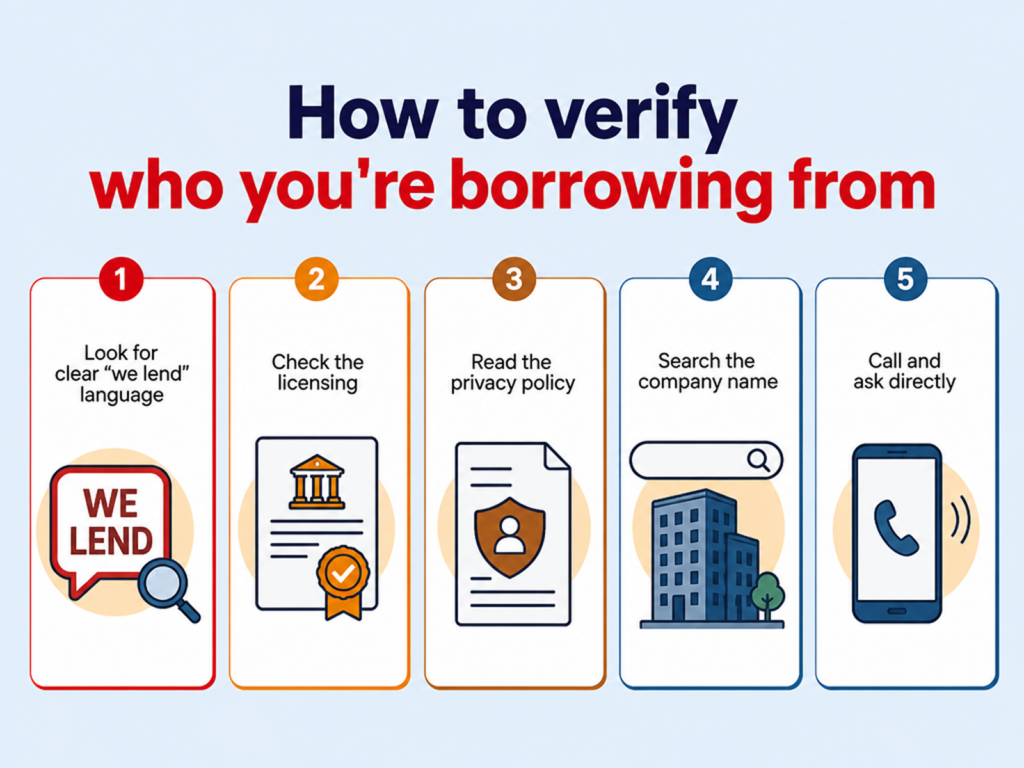
How to verify who you’re borrowing from
Before you share sensitive details, take a few seconds to confirm who’s on the other end:
- Look for clear “we lend” language rather than “we connect you.”
- Check the licensing. In Utah, you can confirm a company’s registration through NMLS Consumer Access.
- Read the privacy policy to see whether your information will be shared with third parties.
- Search the company name to confirm it’s an actual lender rather than a marketing site.
- Call and ask directly. A simple “Do you fund the loan yourselves?” gets you a straight answer fast.
Frequently asked questions
Is it better to go through a broker or a lender?
Neither is automatically better; it depends on your needs. Borrowing directly offers a simpler, more transparent path with one point of contact, while a broker helps you compare multiple offers at once. For fast emergency loans, many borrowers prefer the clarity of working with a single company.
Do brokers charge extra fees?
Some do. A loan broker may charge a separate fee or earn a commission from the lender, which will affect your total cost. Always ask how the company makes money before you apply.
Will applying through a broker affect my credit?
It can. Because a broker may send your application to several lenders, you could see more inquiries and receive more follow-up contacts than you would when applying to one company.
How do I know if a lender is legitimate?
Verify that the company holds a license in your state. Utah borrowers can verify a lender’s registration through the Department of Financial Institutions and NMLS Consumer Access before borrowing.
Can a broker get me a better rate than I can get by borrowing directly?
Not necessarily. A broker shops your application around. Borrowing directly lets you see one clear set of terms upfront, without an added middleman fee built into your cost.
Is USA Cash Services a direct lender?
Yes. USA Cash Services reviews, approves, funds, and services your loan in-house, so you work with one company from application through repayment. There are no third-party handoffs and no confusion about who holds your loan or who to call.
Utah borrowers: what to know locally
If you’re borrowing in Utah, state oversight works in your favor. The Utah Department of Financial Institutions regulates payday and deferred deposit lenders, requiring them to register with the state and the Nationwide Multistate Licensing System.
That means you can confirm a company’s legitimacy before you ever fill out an application, and you’re able to check its standing directly rather than relying on the claims made on a website.
Utah’s own guidance describes payday and deferred deposit loans as a way to access money quickly for temporary cash-flow needs or financial emergencies, and notes that they often cost less than overdraft or late fees when repaid on time.
Choosing a licensed company that funds loans directly gives you the confidence of dealing with a regulated business from application all the way through repayment.
Apply for your loan through USA Cash Services
When you’re facing an unexpected expense, understanding the difference between a company that funds your loan and one that simply refers you elsewhere puts you back in control.
One model funds your loan, holds it, and stays your single point of contact, offering the speed and transparency that matter most when you need emergency loans quickly. The other can widen your options, but often at the cost of clarity about who you’re really working with.
The good news is that the difference is easy to spot once you know what to look for, and a few seconds of checking before you apply will save you confusion and uncertainty about your loan down the road.
At USA Cash Services, we lend to you directly, so from the moment you apply to the day you repay, you’re working with us and only us. If you’re ready to borrow with confidence, explore our loan options or start your application today.